German dental implants in Turkey from €300 per fixture — BEGO, CAMLOG, Dentsply Sirona (Ankylos/Xive), Medentika & more. Compare brands, prices vs Europe, and what makes German engineering stand out. Free consultation. 2026 guide.

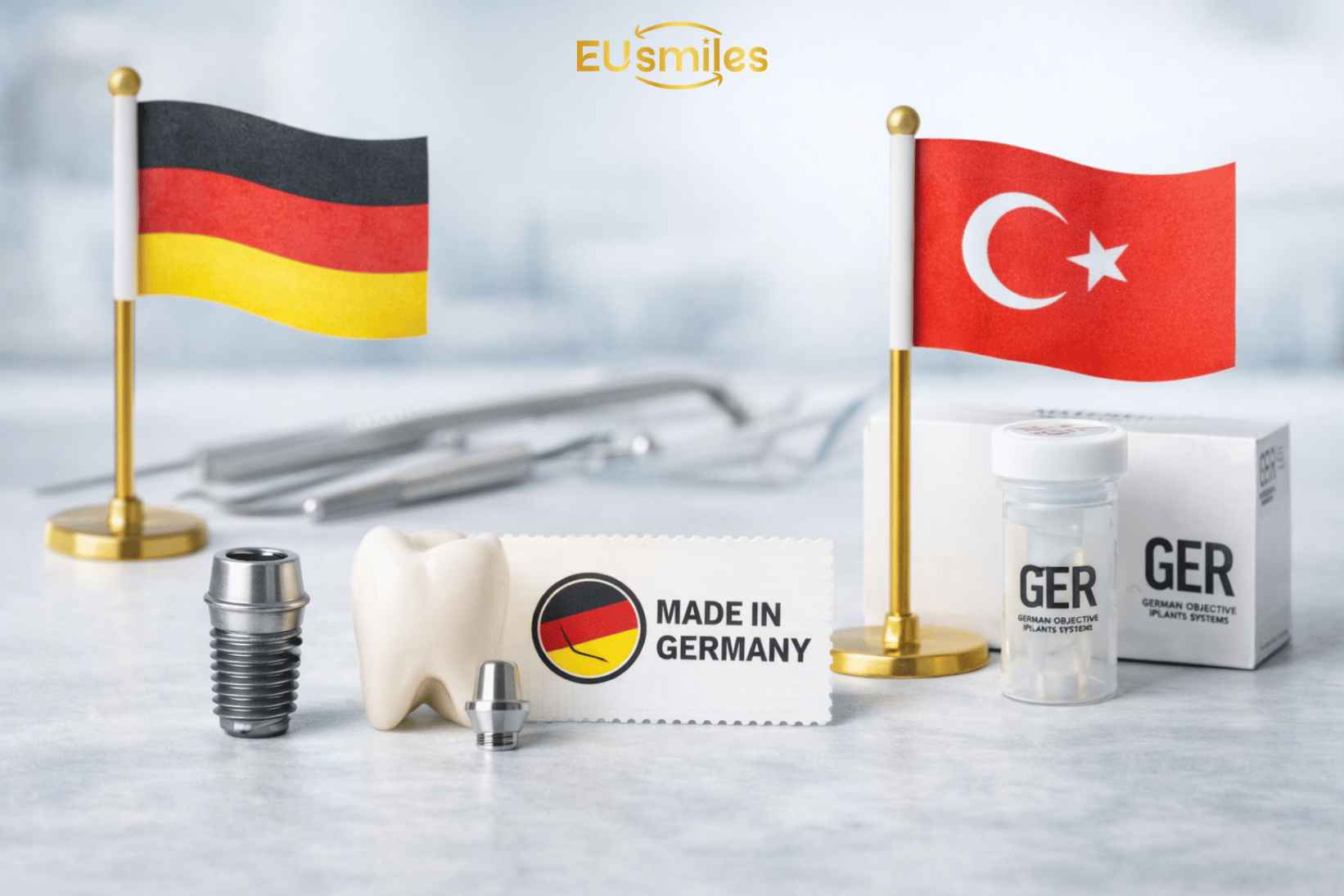
German Brand Dental Implants in Turkey: Complete 2026 Guide to Brands, Prices & Choosing the Right System
Last updated: March 2026 | Reviewed by implant dentistry specialists | Reading time: ~12 minutes
✅ Quick Answer
German brand dental implants in Turkey cost €300–€900 per fixture depending on the brand and system — compared to €800–€2,500 in Germany itself. The main German implant brands available in Turkey are BEGO (Bremen, est. 1890), CAMLOG (Baden-Württemberg, part of Straumann Group), Dentsply Sirona’s Ankylos and Xive systems (originally German), and Medentika (Germany, Straumann Group). Each offers CE/ISO-certified German manufacturing at significantly reduced treatment costs thanks to Turkey’s lower clinical overheads.
When patients search for ‘German brand dental implants in Turkey’, they are typically looking for one thing: the reassurance of German engineering precision at the dramatically lower cost that Turkish dental clinics can offer. It is a reasonable and well-founded instinct. Germany has one of the strongest traditions in dental manufacturing in the world, and several German brands have built decades-long track records in implant dentistry.
This guide clarifies exactly which implant brands are genuinely German, what each system offers clinically, how prices compare between Turkey and Western Europe, and how to make an informed choice between BEGO, CAMLOG, Dentsply Sirona (Ankylos/Xive), Medentika, and the broader German-origin implant landscape — including an honest comparison with Swiss alternatives.
📋 What This Guide Covers: Which implant brands are actually German (and which are not) · Full brand profiles: BEGO, CAMLOG, Dentsply Sirona Ankylos/Xive, Medentika, ICX · EUR price table: Turkey vs Germany vs UK · Brand tier comparison table · German vs Swiss implants: honest clinical comparison · Which German brand suits your case · How to verify genuine German implants · Clinic selection checklist · FAQ
Which Dental Implant Brands Are Actually German? Clearing Up the Confusion
One of the most common sources of confusion in this market is the misclassification of implant brands by country of origin. Before choosing a ‘German brand’, it is worth knowing exactly what that means — and what it does not mean.
| Brand | True Origin | German? | Parent Company | Key Note |
|---|---|---|---|---|
| BEGO | Bremen, Germany | ✅ Yes | Independent (family-owned, 5th generation) | Founded 1890 — 135 years of German manufacturing |
| CAMLOG | Wimsheim, Germany | ✅ Yes | Straumann Group (since 2021) | Premium German engineering; now backed by Swiss Straumann |
| Dentsply Sirona — Ankylos | Mannheim, Germany | ✅ Yes | Dentsply Sirona (US-German merger 2016) | Originally Friadent — genuinely German-engineered system |
| Dentsply Sirona — Xive | Mannheim, Germany | ✅ Yes | Dentsply Sirona | Friadent legacy; tapered design; widely used in Turkey |
| Medentika | Hügelsheim, Germany | ✅ Yes | Straumann Group | German-engineered; compatible with Straumann, Nobel, CAMLOG prosthetics |
| ICX (medentis medical) | Bad Kreuznach, Germany | ✅ Yes | medentis medical GmbH (independent) | Budget-tier German implant; strong value positioning |
| Straumann | Basel, Switzerland | ❌ Swiss | Straumann Group AG (Swiss) | Frequently misclassified as German — it is Swiss |
| Astra Tech (OsseoSpeed) | Mölndal, Sweden | ❌ Swedish | Dentsply Sirona | Swedish-origin; owned by German-US company Dentsply Sirona |
| Nobel Biocare | Zürich, Switzerland | ❌ Swiss | Envista Holdings (US) | Swiss/Swedish origin — not German |
💡 Important Clarification: Straumann is Swiss, not German — despite being frequently listed as a ‘German implant’ on several Turkish dental clinic websites. This is a widespread misclassification. Straumann’s headquarters, manufacturing, and research facilities are in Basel, Switzerland. Nobel Biocare (Swedish/Swiss) and Astra Tech (Swedish, owned by Dentsply Sirona) are also not German brands. The genuinely German brands are BEGO, CAMLOG, Ankylos, Xive, Medentika, and ICX.
German Dental Implant Brands Available in Turkey: Brand-by-Brand Profiles
BEGO — Bremen, Germany (Founded 1890)
BEGO is one of the oldest dental companies in the world, founded in Bremen in 1890 and now in its fifth generation of family ownership. Its implant division has been active since 1994, producing titanium implant systems that are distributed in over 83 countries.
Key systems: BEGO’s main implant line is the Semados series, offering bone-level and tissue-level options in both tapered and straight configurations across a wide range of diameters and lengths. The surface treatment promotes rapid osseointegration, and the system is compatible with a range of prosthetic options including zirconia crowns and hybrid prostheses.
Clinical positioning: BEGO occupies the mid-premium segment — above budget Korean and Turkish brands, but below Straumann and Nobel Biocare in price. Its strength is the combination of genuine German manufacturing quality, CE and ISO certification, international parts availability (component database on spotimplant.com), and a lifetime warranty against manufacturing defects.
Turkey price range: €300–€600 per fixture (implant only). Complete single-tooth restoration all-inclusive: €600–€1,100. Suitable for All-on-4 and All-on-6 full-arch cases.
Best for: Patients seeking German manufacturing quality at mid-premium pricing. Particularly well-suited to patients who want CE/ISO-certified German implants with global parts availability without paying the full Straumann or Nobel Biocare premium.
CAMLOG — Wimsheim, Germany (Now Part of Straumann Group)
CAMLOG is one of Germany’s most respected implant systems, manufactured in Wimsheim, Baden-Württemberg, and widely used by European implantologists for its precision engineering and documented clinical performance. In 2021, CAMLOG was acquired by the Straumann Group, giving it Swiss-backed research and distribution infrastructure while maintaining its German manufacturing base.
Key systems: CAMLOG’s Conical Connection implant system is known for its precision-fit connection geometry, which reduces micro-movements at the implant-abutment interface — an important factor in long-term peri-implant tissue health. The CAMLOG Tube-in-Tube (TiT) connection offers a distinctive triple-indexed internal connection. The system integrates with digital CAD/CAM prosthetic workflows.
Clinical positioning: Premium tier. Real-world practice data shows strong long-term performance in daily practice settings. CAMLOG is particularly favoured by European implantologists for demanding aesthetic cases and patients requiring complex full-arch rehabilitation. Its acquisition by Straumann Group provides additional long-term supply chain and clinical research security.
Turkey price range: €400–€750 per fixture. Complete single-tooth restoration all-inclusive: €800–€1,400.
Best for: Patients prioritising documented German engineering consistency, aesthetic zone cases, or complex restorative cases. The Straumann Group backing provides additional component availability assurance for long-term European serviceability.
Dentsply Sirona: Ankylos — Mannheim, Germany
Ankylos is the implant system developed by Friadent — a genuinely German implant company founded in Mannheim that was subsequently acquired by Dentsply Sirona following that company’s 2016 US-German merger. Ankylos has decades of clinical data and is particularly notable for its TissueCare Concept.
Key innovation — TissueCare Connection: Ankylos features a Tapered TissueCare Connection designed to create a sealed implant-abutment interface that minimises micro-movements and bacterial leakage at the connection. This design is specifically engineered to support long-term peri-implant tissue preservation — keeping the bone and gum around the implant neck stable over time. Large cohort data for Ankylos reports high long-term cumulative survival, with most failures clustered early (before final prosthesis placement), a pattern consistent across modern implantology.
Turkey price range: €350–€700 per fixture. Complete single-tooth restoration all-inclusive: €700–€1,300.
Best for: Patients where peri-implant bone and tissue preservation is a priority — particularly in cases with thin soft tissue, aesthetic zone demands, or patients with a history of periodontal disease requiring long-term tissue stability.
Dentsply Sirona: Xive — Mannheim, Germany
Xive is the second major implant system from Dentsply Sirona’s German heritage, also originally developed by Friadent. Where Ankylos prioritises tissue health through its connection geometry, Xive is designed for high primary stability enabling immediate or early loading protocols.
Key Features
- Xive features a tapered body design with the Friadent Plus surface — a modified titanium surface that supports osseointegration and healing.
- Its self-cutting tapered design provides excellent initial stability in variable bone types, including softer D3/D4 bone conditions.
- Xive integrates with Dentsply Sirona’s Atlantis CAD/CAM abutment system for customised prosthetics.
Turkey price range: €320–€650 per fixture. Complete single-tooth restoration all-inclusive: €650–€1,200.
Best for: Cases requiring immediate loading; post-extraction sites; patients with soft bone where high primary stability is needed from day one.
Medentika — Hügelsheim, Germany (Straumann Group)
Medentika is a German implant and prosthetic components company headquartered in Hügelsheim, Baden-Württemberg, acquired by the Straumann Group. What makes Medentika uniquely valuable is its cross-brand prosthetic compatibility: Medentika produces premium-quality components that are compatible with Straumann, Nobel Biocare, CAMLOG, and several other major implant systems.
Key Advantage
Medentika allows a clinic to use its German-engineered prosthetic components (abutments, crowns, multi-unit abutments) with a range of implant fixtures — making it a highly versatile option for clinics serving international patients who may have existing implants from another brand. The Straumann Group backing provides clinical data depth and supply chain security.
Turkey price range: €250–€550 per fixture. Complete single-tooth restoration all-inclusive: €550–€1,000.
Best for: Patients looking for the Straumann Group quality umbrella at a more accessible price point. Also valuable for patients with existing implants of another brand who need replacement crowns or abutments.
ICX (medentis medical) — Bad Kreuznach, Germany
ICX is produced by medentis medical GmbH, an independent German manufacturer based in Bad Kreuznach, Rhineland-Palatinate. ICX is positioned as a budget-tier German implant — CE and ISO certified, manufactured in Germany, but priced significantly below premium brands.
Clinical Positioning
ICX occupies the value tier within the German implant segment. It provides the assurance of German manufacturing standards and CE/ISO certification at a price point comparable to Korean brands such as Osstem. For patients who specifically want ‘German-made’ but cannot stretch to CAMLOG or Ankylos pricing, ICX is a legitimate clinical option.
Turkey price range: €200–€400 per fixture. Complete single-tooth restoration all-inclusive: €450–€800.
Best for: Budget-conscious patients who specifically require German manufacturing certification, or cases where a higher number of implants makes premium brand pricing prohibitive.
German Brand Dental Implants Turkey: EUR Price Comparison Table 2026
All prices below represent the total all-inclusive treatment cost (fixture + abutment + zirconia crown + CBCT scan + surgical fee) per single tooth. Fixture-only prices are also shown for comparison:
| Brand | Origin | Tier | Turkey (fixture) | Turkey (all-in single) | Germany (all-in single) | Saving |
|---|---|---|---|---|---|---|
| BEGO | Germany | Mid-Premium | €300–€600 | €600–€1,100 | €1,400–€2,800 | Up to €1,700 |
| CAMLOG | Germany | Premium | €400–€750 | €800–€1,400 | €1,800–€3,200 | Up to €1,800 |
| Ankylos (Dentsply) | Germany | Premium | €350–€700 | €700–€1,300 | €1,800–€3,500 | Up to €2,200 |
| Xive (Dentsply) | Germany | Premium | €320–€650 | €650–€1,200 | €1,600–€3,200 | Up to €2,000 |
| Medentika | Germany | Mid-Premium | €250–€550 | €550–€1,000 | €1,200–€2,500 | Up to €1,500 |
| ICX (medentis) | Germany | Value | €200–€400 | €450–€800 | €900–€1,800 | Up to €1,000 |
| Straumann (Swiss — for comparison) | Switzerland | Ultra-Premium | €280–€600 | €700–€1,300 | €2,500–€4,500 | Up to €3,200 |
⚠️ Always Request All-Inclusive Pricing: Some clinics advertise only the fixture price — the bare implant screw. The abutment, crown, CBCT scan, and surgical fee are all additional. Always request a fully itemised all-inclusive quote covering every component before comparing prices across clinics or countries.
German vs Swiss Dental Implants: An Honest Clinical Comparison
| Factor | German Systems (BEGO, CAMLOG, Ankylos) | Swiss Systems (Straumann, Nobel Biocare) |
|---|---|---|
| Manufacturing standard | CE/ISO 13485 certified German manufacturing. Rigorous DIN standards compliance. | CE/ISO 13485 certified Swiss manufacturing. Equivalent regulatory standard. |
| Surface technology | CAMLOG: strong osseointegration data. Ankylos: TissueCare Connection for bone preservation. BEGO: treated surface for rapid integration. | Straumann SLActive: fastest healing (3–6 weeks loading). Nobel TiUnite: excellent primary stability in soft bone. |
| Long-term survival data | CAMLOG: strong real-world performance data. ANKYLOS: large cohort data, high cumulative survival. BEGO: 30+ years distribution in 83 countries. | Straumann: 97–99% at 10 years (extensive multi-centre data). Nobel: 97–98% at 10 years. Deepest global evidence base. |
| Price in Turkey (all-in single) | €600–€1,400 depending on brand and system | €700–€1,300 (Straumann). Overlap is significant. |
| European component serviceability | CAMLOG: excellent (Straumann Group). Ankylos/Xive: Dentsply Sirona global distribution. BEGO: spotimplant.com database; 83 countries. ICX: smaller distribution network. | Straumann: exceptional — any European implantologist can source parts. Nobel: equivalent global availability. |
| Full-arch (All-on-X) | CAMLOG: strong for full-arch. Ankylos/BEGO: suitable but less All-on-X specific data than Nobel. | Nobel Biocare: deepest All-on-4 protocol evidence (Nobel invented it). Straumann BLX: strong immediate loading data. |
| Price in Germany (all-in single) | €1,200–€3,500 (varies by brand) | €2,500–€4,500 (Straumann) |
Which German Brand Is Right for Your Case?
| Your Situation | Recommended German Brand | Why |
|---|---|---|
| Single tooth; strong bone; standard case | CAMLOG or BEGO | Both offer excellent results; CAMLOG for premium, BEGO for value |
| Peri-implant tissue health is priority (history of gum disease) | Ankylos (Dentsply Sirona) | TissueCare Connection specifically designed for long-term bone and tissue stability |
| Soft bone (D3/D4); immediate loading desired | Xive (Dentsply Sirona) | Tapered self-cutting design provides high primary stability in difficult bone |
| Full-arch All-on-4 or All-on-6 | CAMLOG or Ankylos | Both have documented full-arch case data; CAMLOG backed by Straumann Group infrastructure |
| Budget-conscious; German certification required | BEGO or ICX | CE/ISO German manufacturing at mid or entry pricing |
| Existing implant of another brand; replacement crown needed | Medentika | Compatible with Straumann, Nobel, CAMLOG systems; German-made prosthetics |
| Premium full-arch; maximum evidence base priority | Consider Straumann or Nobel (Swiss) | If evidence depth and SLActive healing speed matter most, Swiss brands hold the advantage |
Why Are German Brand Implants Available in Turkey at Lower Prices?
The implant is manufactured in Germany to German and EU standards. BEGO’s production facility is at the Technology Park of the University of Bremen. CAMLOG manufactures in Wimsheim. Ankylos and Xive are produced in Mannheim. The CE and ISO 13485 certifications these implants carry apply to the product, not to the country in which they are placed. A BEGO implant placed in Istanbul carries the same German manufacturing certification as one placed in Düsseldorf.
Turkish clinics access the same implants through authorised European distribution networks. Accredited Turkish dental clinics sourcing German implants work through authorised distributors — the same supply chain used by European practices. BEGO notes that changes in the euro exchange rate directly affect Turkish pricing, which confirms that the product is genuinely imported through standard European distribution channels, not produced locally.
Lower overheads reduce the treatment cost — not the implant cost. Just as with Swiss brands, the savings available in Turkey are driven entirely by lower clinical overheads — surgeon salaries, clinic rent, in-house laboratory costs, and support staff — not by any difference in the implant component or its manufacturing standard.
💡 Practical Takeaway: When a Turkish clinic places a BEGO, CAMLOG, or Ankylos implant, you receive the same German-certified component as in any European clinic. The all-inclusive treatment cost — including the Turkish clinic’s overheads, laboratory, and accommodation — is still typically 50–70% lower than the equivalent treatment price in Germany, the Netherlands, or the UK.
How to Verify Your Clinic Is Using Genuine German Implants
- Before booking, request written confirmation of the exact brand, system name, and model (e.g. ‘BEGO Semados RS, 4.1mm × 10mm’ or ‘CAMLOG Conical Connection, 4.3mm × 11mm’). Reputable clinics confirm this without hesitation.
- On the day of surgery, ask to see the sealed implant packaging before the procedure begins. Genuine German implants (BEGO, CAMLOG, Ankylos, Xive, Medentika) are supplied in individually sealed, sterile, single-use packaging with the brand name, product code, CE mark, and batch/lot number clearly visible.
- Photograph the packaging. This gives you the full product reference and batch number — essential for any future European dentist servicing your implant.
- Ask for the implant batch sticker from the packaging. Most accredited Turkish clinics add this to your patient file as standard clinical documentation.
- For CAMLOG (Straumann Group) and Medentika (Straumann Group), component traceability can be verified through Straumann Group’s global documentation systems. For BEGO, components are traceable via spotimplant.com’s verified database.
- After treatment, keep your full implant documentation permanently — the brand, model, diameter, length, and batch number. Share this with your home-country dentist at your first post-treatment visit.
⚠️ Red Flag: If a Turkish clinic cannot tell you the exact German brand and model, or is unwilling to show packaging before surgery, this is a serious concern regardless of what they claim to use. Any accredited clinic placing genuine German implants will welcome this verification process.
How to Choose a Safe Clinic for German Brand Implants in Turkey
✅ Non-Negotiable Checklist
- Ministry of Health (Republic of Turkey) Health Tourism Authorisation — current certificate on website or available on request
- International accreditation: ISO 9001, AACI, or JCI
- Named implantologist with verifiable qualifications — ideally ITI or EAO membership
- Written confirmation of the exact German implant brand, system, and model before any payment
- Sealed implant packaging shown and photographed before surgery
- 3D CBCT scan included and reviewed before treatment planning — not just panoramic X-ray
- In-house dental laboratory with CAD/CAM digital milling capability
- Minimum 200 verified independent reviews on Google / Trustpilot mentioning implant treatment
- Full documentation package: batch number, implant sticker, and handover notes for home-country dentist
- Written guarantee — typically lifetime on fixture, 5–10 years on crown
Questions to Ask Before Booking
- Which exact German implant brand, system, and model will you use for my case?
- Can you confirm this in writing and show me the implant packaging before surgery?
- Is the 3D CBCT scan included in the quoted package price?
- What documentation will you provide for my home-country dentist?
- Does the package cover both trips — surgery and crown fitting?
- What is your aftercare protocol for patients returning to Europe?
Treatment Timeline: German Brand Implants in Turkey
| Phase | What Happens | Duration |
|---|---|---|
| Online Consultation | Share X-rays or photos; receive personalised German brand recommendation; itemised EUR quote | Before travel — free |
| First Trip — Surgery | CBCT scan; treatment plan confirmation; packaging verification; German implant fixture placed under local anaesthetic; temporary crown or healing abutment; post-surgical check | 5–7 days in Turkey |
| Osseointegration | Healing at home. BEGO/CAMLOG/Ankylos: 8–12 weeks standard healing. Xive: early loading sometimes possible from 6–8 weeks depending on primary stability. | 6–16 weeks at home |
| Second Trip — Crown | Osseointegration confirmed; abutment placed; digital crown impressions; zirconia crown fabricated in-house; trial fitting; final bonding; guarantee documents issued | 3–5 days in Turkey |
| Long-term Maintenance | Annual check-ups and hygienist visits at home-country dentist using German implant documentation provided by Turkish clinic | Ongoing — 6–12 monthly |
Frequently Asked Questions
Is Straumann a German implant brand?
No. Straumann is Swiss — headquartered and manufactured in Basel, Switzerland. It is one of the most commonly misclassified brands on Turkish dental clinic websites, where it is frequently listed as a ‘German implant’. The genuinely German brands available in Turkey are BEGO, CAMLOG, Dentsply Sirona’s Ankylos and Xive systems, Medentika, and ICX.
Which is the best German dental implant brand available in Turkey?
For most patients, CAMLOG and Ankylos represent the strongest combination of German engineering quality and long-term clinical evidence. CAMLOG’s acquisition by the Straumann Group adds component availability security. Ankylos’s TissueCare Connection is particularly well-evidenced for peri-implant tissue stability. BEGO is the best choice for patients seeking mid-premium German quality at a lower price point. The right brand depends on your clinical case — ask your implantologist to recommend based on your CBCT scan data.
Are BEGO implants good quality?
Yes. BEGO has been manufacturing dental products in Bremen, Germany since 1890 and has been producing CE/ISO-certified titanium implants since 1994. BEGO implants are distributed in over 83 countries and have a documented track record in both single-tooth and full-arch (All-on-4/6) applications. They are widely regarded as a reliable mid-premium option — above budget Korean and Turkish brands, at a more accessible price than Straumann or CAMLOG. BEGO provides a lifetime warranty against manufacturing defects.
What is CAMLOG’s connection to Straumann?
CAMLOG was acquired by the Straumann Group in 2021. It continues to be manufactured in Germany with its own German engineering identity, but now benefits from Straumann Group’s research infrastructure, global distribution network, and clinical data resources. For patients concerned about long-term component availability in Europe, CAMLOG’s Straumann Group membership provides additional assurance.
What is the Ankylos TissueCare Concept?
The Ankylos TissueCare Connection is a sealed, tapered implant-abutment interface specifically designed to minimise micro-movements and bacterial leakage at the connection between the implant and the crown component. This design reduces the biological triggers of peri-implant bone loss, helping to maintain stable bone and gum levels around the implant over time. Large cohort clinical data supports high long-term survival rates. Ankylos is particularly recommended for patients with a history of periodontal (gum) disease or thin soft tissue at the implant site.
Can a European dentist service my German implants placed in Turkey?
For CAMLOG and Medentika (both Straumann Group): yes, with full global component availability. For Ankylos and Xive (Dentsply Sirona): yes, Dentsply Sirona has a strong European distribution network. For BEGO: components are traceable and available via spotimplant.com’s global database and BEGO’s own 83-country distribution network. For ICX: smaller distribution network; confirm availability in your home country before choosing this option. Always carry your full implant documentation to ensure any European dentist can identify and service your restoration.
Are German implants better than Korean implants (e.g. Osstem) for Turkey treatment?
Both are clinically viable options for different budgets. Korean brands like Osstem are the most widely used implants globally by volume and have strong performance data at competitive prices. German brands (BEGO, CAMLOG, Ankylos) offer European manufacturing certification, longer institutional track records, and generally stronger component availability networks across Western Europe. For patients returning to Germany, Austria, the Netherlands, or the UK for long-term maintenance, German and Swiss brands offer a more seamless serviceability pathway than Korean alternatives.
Summary: German Brand Dental Implants in Turkey — Who Should Choose Them?
German brand dental implants in Turkey make the most sense for patients who specifically value European manufacturing standards, long-term component availability in European dentistry networks, and documented clinical performance — while benefiting from Turkey’s dramatically lower treatment costs.
CAMLOG is the premium German choice, backed by Straumann Group since 2021. Ankylos is the specialist choice for peri-implant tissue health and bone preservation. BEGO is the best value German option with 135 years of manufacturing heritage. Medentika offers German-made prosthetics compatible with multiple implant systems. Xive is ideal for patients requiring immediate loading in difficult bone conditions.
Across all these brands, Turkey provides savings of 50–70% compared to the same treatment in Germany, the Netherlands, or the UK — not because the quality is lower, but because the clinical overheads surrounding the procedure are structurally lower in Turkey. The German implant itself is the same CE-certified component, from the same German factory, regardless of where it is placed.
The most important decisions are: verify the exact brand and model in writing before booking, confirm sealed packaging before surgery, obtain full batch documentation, choose an accredited clinic with an in-house laboratory, and ensure your implantologist is experienced with your chosen German system.
You May Also Like
Zirconia vs Porcelain Crowns: What Latvians Should Choose
Why Latvian Patients Prefer Dental Treatment in Turkey
Why Antalya Is Popular Among Latvian Dental Tourists
Veneers in Turkey: A Guide for Latvian Patients
Smile Makeover Options in Turkey for Latvian Patients
Is Turkey a Safe Destination for Dental Tourism from Latvia?
How to Travel from Latvia to Turkey for Dental Treatment
How Many Trips Do Latvian Patients Need for Dental Implants?
Hidden Costs in Dental Tourism: What Latvian Patients Should Know
All-on-6 Dental Implants for Patients from Latvia
Dental Treatment Packages in Turkey for Latvian Patients
Dental Implants Recovery Time: What Latvians Should Expect
Dental Implants Cost in Turkey vs Latvia: Full Comparison
Are Turkish Dental Clinics EU-Standard for Latvian Patients?
Before & After Dental Implant Results for Latvian Patients
Click to rate this post!
[Total: 1 Average: 5]

Dr. Hakan Hasgül - Dentistry
I am a Cosmetic Dentist with 18 years of hands-on experience, having transformed more than 6,200 smiles. My practice is rooted in personalized care, artistic precision, and long-lasting results. I firmly believe that a beautiful smile can elevate confidence and overall well-being. Committed to continual growth, I embrace the latest dental innovations and techniques to provide my patients with exceptional, cutting-edge care.