Titanium or zirconia implants in Turkey — which is better for you? Compare cost, success rates, aesthetics, longevity, and clinical evidence. Make the right choice for your case.

Titanium vs Zirconia Implants in Turkey (2026): The Complete Guide
Whether you are planning a single tooth replacement or a full-arch restoration in Turkey, one of the first clinical decisions you will face is: titanium or zirconia? Both materials are biocompatible, both integrate with jawbone, and both are available at Turkey’s leading clinics. But they behave very differently inside the body — and the wrong choice for your clinical situation can affect your outcome for decades. This guide is built on the latest clinical research — including a 2025 systematic review in the journal Surgeries (Abreu et al.) and a 2023 meta-analysis in PeerJ (Wang et al.) — alongside real Turkish clinic pricing, material science facts, and a decision framework to help you choose with confidence.
Quick Answer: Titanium or Zirconia?
Choose TITANIUM if you…
✔ Have heavy bite forces or bruxism (teeth grinding)
✔ Need a full-arch restoration (All-on-4 / All-on-6)
✔ Have complex bone conditions requiring flexibility
✔ Want the material with the longest clinical history (60+ years)
✔ Are on a tighter budget
✔ Have no aesthetic concerns about gum transparency
Choose ZIRCONIA if you…
✔ Want a 100% metal-free, holistic solution
✔ Have a confirmed or suspected titanium sensitivity
✔ Have thin gum tissue (to avoid grey gum lines)
✔ Are replacing a front tooth where aesthetics are paramount
✔ Prioritise lower plaque adhesion and gum health
✔ Are comfortable with a 20–30% price premium
What Are Titanium and Zirconia Implants?
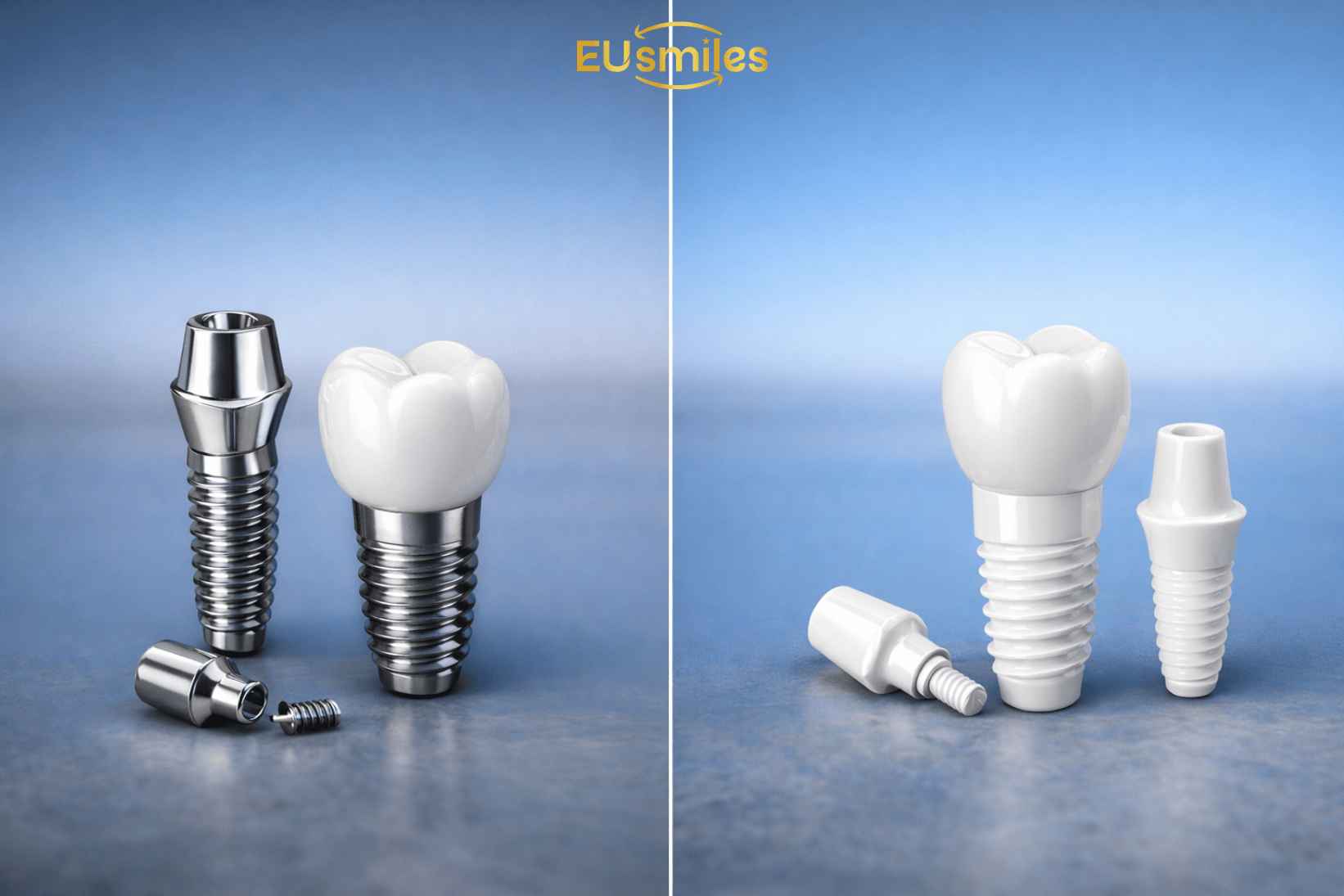
Titanium Implants
Titanium dental implants are the gold standard of implant dentistry and have been used clinically since 1965. Made from medical-grade titanium (Grade 4 commercially pure titanium or Grade 5 Ti-6Al-4V alloy), they form a direct structural bond with jawbone through a process called osseointegration — first documented by Professor Per-Ingvar Brånemark. Today, premium titanium implants feature advanced surface treatments — such as Straumann’s SLActive® hydrophilic coating — that accelerate bone bonding, reducing healing time to 3–4 weeks from the traditional 6–8 weeks. Titanium is also used across medical disciplines: joint replacements, spinal fixators, cardiac pacemakers, and bone conduction hearing aids — underscoring its universal biocompatibility.
Zirconia Implants
Zirconia implants are made from zirconium dioxide (ZrO₂) — a high-strength white ceramic material. They represent the newer generation of implant technology, with clinical use growing significantly since 2015. Leading zirconia implant systems include Straumann PURE, Zimmer Biomet, Nobel Biocare’s ceramic options, Dentsply Sirona, and BioHorizons. Premium zirconia implants are manufactured using yttria-stabilised zirconia (Y-TZP) — the same ceramic used in aerospace and biomedical engineering — shaped by advanced CAD/CAM milling and sintered in precision furnaces. Demand has surged: industry data shows a 300% increase in zirconia implant placements since 2018, driven by rising patient demand for metal-free and holistic dental solutions.
Clinical Evidence: What the Research Actually Says
| Clinical Factor | Titanium | Zirconia |
|---|---|---|
| Clinical history | 60+ years (millions of cases) | ~10–15 years (growing evidence base) |
| 10-year success rate | 95.7% (Journal of Dental Research, 2023) | 92.3% at 7 years — limited 10yr data |
| 5-year success rate (RCTs) | Higher — established baseline | ~66% in some RCTs (PeerJ, Wang et al. 2023) |
| Osseointegration (bone-implant contact) | 65–85% — extensively documented | Comparable — evidence growing |
| Early failure rate (first 12 months) | 2.1% | 3.4% |
| Titanium allergy incidence | 0.6% of population | Zero documented hypersensitivity cases |
| Peri-implantitis risk | Standard | Lower — plaque-resistant smooth surface |
| Fracture risk | Very low (flexible under load) | Higher if standard zirconia; reduced with HIP Y-TZP |
| Long-term lifespan | 20–30+ years well documented | 15–20+ years projected (insufficient long-term data) |
Key Research Finding (2025)
A systematic review by Abreu, Correia, Caetano & Faria-Almeida published in the journal Surgeries (2025) found that while both materials show promising results, titanium maintains a stronger long-term evidence base. The PeerJ meta-analysis by Wang et al. (2023) found zirconia 5-year success rates of approximately 66% in randomised controlled trials — lower than the titanium benchmark. However, this gap narrows significantly when premium yttria-stabilised zirconia systems from Straumann or Nobel Biocare are used.
Head-to-Head: Material Properties Compared
| Property | Titanium | Zirconia | Advantage |
|---|---|---|---|
| Tensile strength | Up to 1,000 MPa — high flexibility | Compressive strength 1,200–1,500 MPa — rigid | Titanium (flexibility under load) |
| Fracture resistance | Extremely resistant — slight flex absorbs bite forces | Rigid — micro-fracture risk under extreme load | Titanium |
| Aesthetics | Metallic grey — may show through thin gums | Natural white — matches teeth and gum colour | Zirconia |
| Plaque adhesion | Standard ceramic or SLA surface | Smooth ceramic — statistically lower plaque adhesion | Zirconia |
| Biocompatibility | Excellent — 60 years of medical proof | Excellent — ceramic, zero metal ions | Tie |
| Metal sensitivity | 0.6% allergy risk | Zero documented reactions | Zirconia |
| Design flexibility | Multi-component — suited for complex cases | Mostly one-piece — limits design options | Titanium |
| Manufacturing cost | Lower | Higher (CAD/CAM milling + sintering furnaces) | Titanium |
| Surface treatment options | SLActive, SLA, TiUnite — multiple advanced options | Limited — fewer surface modification technologies | Titanium |
Aesthetics: The Key Reason Patients Choose Zirconia
The most compelling reason to choose zirconia over titanium is gingival aesthetics — particularly for patients with thin or receding gum tissue. When a titanium implant is placed near the gum line, a subtle grey shadow can sometimes be visible through translucent gum tissue — especially for front teeth. Zirconia eliminates this entirely.
| Aesthetic Factor | Titanium | Zirconia |
|---|---|---|
| Implant colour | Metallic grey | Natural white — matches enamel |
| Gum shadow risk | Possible with thin gum tissue | None — white ceramic blends with tissue |
| Crown-implant transition | May require masking with custom abutment | Seamless — natural appearance from root to crown |
| Best for location | Posterior teeth (molars, premolars) | Anterior teeth (front teeth, canines) |
| Holistic/metal-free appeal | No | Yes — ceramic, no metal ions released |
Clinical recommendation: If your implant is in a visible zone (front six teeth) and you have thin gum tissue, the aesthetic argument for zirconia is strong. For molars and posterior teeth where strength matters most and the implant is not visible, titanium’s biomechanical advantages outweigh the aesthetic benefits of ceramic.
Titanium vs Zirconia Implant Prices in Turkey (2026)
Turkey offers both materials at a fraction of Western European or US prices. Here is a full price comparison:
| Treatment | Titanium (Turkey) | Zirconia (Turkey) | UK Price | US Price |
|---|---|---|---|---|
| Standard implant + crown | $400 – $900 | $600 – $1,200 | £1,800 – £3,000 | $3,000 – $5,000 |
| Premium (Straumann/Nobel) | $700 – $1,050 | $900 – $1,500 | £2,500 – £3,500 | $4,000 – $6,000 |
| All-on-4 (1 jaw) | $5,000 – $9,000 | $8,000 – $14,000 | £12,000 – £18,000 | $20,000 – $35,000 |
| All-on-6 (1 jaw) | $6,000 – $12,000 | $10,000 – $18,000 | £15,000 – £22,000 | $25,000 – $40,000 |
| Full mouth (both jaws) | $12,000 – $20,000 | $18,000 – $30,000 | £25,000 – £45,000 | $40,000 – $80,000 |
* Zirconia implants cost 20–30% more than titanium equivalents due to higher manufacturing costs (CAD/CAM milling + precision sintering). Prices include implant, abutment, and crown unless stated otherwise.
Why Are Zirconia Implants More Expensive?
Zirconia manufacturing requires advanced 3D milling technology, precision oven-curing (sintering) processes, and significantly more clinical planning time. The one-piece design also limits surgical flexibility, meaning a zirconia case typically requires more extensive 3D pre-planning. When comparing Straumann PURE (zirconia) vs Straumann BLX (titanium) in Turkey, expect a 20–30% premium for the ceramic option.
Patient Decision Guide: Which Implant Is Right for You?
| Patient Situation | Recommended Material | Reason |
|---|---|---|
| Heavy bite forces / bruxism (teeth grinding) | Titanium | Zirconia’s rigidity increases micro-fracture risk under extreme load |
| Front tooth replacement (aesthetic zone) | Zirconia | No grey shadow risk; white ceramic blends naturally with gum and enamel |
| Full-arch restoration (All-on-4 / All-on-6) | Titanium | Multi-component titanium systems have proven biomechanics for full-arch load |
| Confirmed titanium allergy or metal sensitivity | Zirconia | Ceramic = zero metal ions, zero documented hypersensitivity |
| Thin gum tissue / visible implant line concern | Zirconia | White ceramic eliminates grey shadow visible through thin gums |
| Holistic / metal-free dentistry preference | Zirconia | Ceramic material — no metal components, supports integrative health approach |
| Bone deficiency requiring grafting | Titanium | Multi-component titanium adapts better to complex bone reconstruction cases |
| Molar replacement (heavy occlusal forces) | Titanium | Peak molar chewing forces exceed safe load range for standard-grade zirconia |
| Budget-conscious patient | Titanium | 20–30% more affordable; equivalent long-term outcomes for most standard cases |
| Uncontrolled diabetes or smoking history | Titanium | Better documented evidence base for compromised healing environments |
Top Implant Brands Available in Turkey: Titanium & Zirconia
Premium Titanium Brands
- Straumann® BLX / SLActive — Swiss, highest 10-year success data, 3–4 week osseointegration
- Nobel Biocare® (TiUnite surface) — Swiss, pioneer of All-on-4 protocol
- Dentsply Sirona® Astra Tech — Swedish engineering, strong gum tissue response
- Zimmer Biomet® Tapered Screw-Vent — US brand, widely used in complex reconstructions
- Osstem® (Korea) — high-volume, cost-effective, 15+ year clinical data
- Megagen® AnyRidge (Korea) — strong primary stability in softer bone
Premium Zirconia Brands
- Straumann® PURE Ceramic — gold standard zirconia; yttria-stabilised, single-piece design
- Nobel Biocare® Ceramic — zirconia abutment + crown system
- Zimmer Biomet® Zirconia — multi-piece system for increased design flexibility
- Dentsply Sirona® Atlantis Zirconia — digital workflow integration
- BioHorizons® Tapered Internal Zirconia — solid osseointegration data
Brand Recommendation for Zirconia in Turkey
If choosing zirconia, insist on Straumann PURE or Nobel Biocare ceramic systems. Generic or unbranded zirconia implants may not use premium yttria-stabilised material, increasing fracture risk. The manufacturing quality gap between premium and budget zirconia is far greater than in titanium — do not compromise on brand for ceramic implants.
Titanium: Pros & Cons
Advantages
- ✔ 60+ years of clinical evidence with millions of documented cases worldwide
- ✔ 10-year success rates consistently above 95%
- ✔ Superior tensile strength and flexibility — safer under heavy bite forces and bruxism
- ✔ Multiple advanced surface technologies (SLActive, TiUnite, SLA) — faster healing
- ✔ Versatile multi-component designs for complex, full-arch, and bone-grafted cases
- ✔ 20–30% more affordable than zirconia equivalents
- ✔ Titanium allergy is extremely rare (0.6% of population)
- ✔ Used across all medical disciplines — strongest biocompatibility proof
Disadvantages
- ✘ Grey metallic colour may be visible through thin gum tissue — cosmetic concern for front teeth
- ✘ Contains metal — not suitable for the small percentage with confirmed titanium sensitivity
- ✘ Not ideal for holistic or metal-free dentistry patients
Zirconia: Pros & Cons
Advantages
- ✔ 100% metal-free ceramic — no metal ions released into body tissue
- ✔ Natural white colour — eliminates grey shadow risk through thin gum tissue
- ✔ Lower plaque adhesion than titanium — statistically lower peri-implantitis risk
- ✔ Zero documented hypersensitivity or allergic reactions
- ✔ Preferred by patients pursuing holistic or integrative health approaches
- ✔ Excellent aesthetic outcomes for anterior (front tooth) restorations
Disadvantages
- ✘ Shorter clinical history — limited long-term data beyond 10 years
- ✘ Higher early failure rate: 3.4% vs 2.1% for titanium in first 12 months
- ✘ Rigid ceramic — higher micro-fracture risk under heavy bite forces or bruxism
- ✘ Not recommended for full-arch restorations (All-on-4 / All-on-6) with standard systems
- ✘ 20–30% more expensive than titanium
- ✘ Limited surface treatment options compared to titanium
- ✘ Mostly one-piece design — less surgical flexibility for complex bone situations
Frequently Asked Questions
Is zirconia as strong as titanium?
In terms of compressive strength, zirconia is technically stronger (1,200–1,500 MPa vs titanium’s ~1,000 MPa). However, titanium is more flexible — it slightly flexes under load, which is biomechanically superior for absorbing bite forces without fracture. Zirconia’s rigidity makes it more vulnerable to micro-fracture under extreme or off-axis loading, particularly for molar teeth or patients with bruxism.
Which lasts longer — titanium or zirconia?
Titanium has documented success rates above 95% at 10 years with 20–30+ year case histories. Zirconia projects a lifespan of 15–20+ years based on current medium-term data, but long-term evidence beyond 10 years is still limited. Premium yttria-stabilised zirconia from brands like Straumann PURE narrows this gap significantly.
Can I have an All-on-4 with zirconia implants?
Standard full-arch All-on-4 and All-on-6 protocols use titanium implants — the biomechanical demands of supporting an entire arch’s bite force are better served by titanium’s flexibility. However, the crowns and bridge superstructure of an All-on-4 are very commonly made from zirconia ceramic, which is excellent for aesthetics. Zirconia implant screws for full-arch cases remain experimental and are not recommended at mainstream clinics.
Is there a risk of titanium allergy with implants?
Yes, but it is extremely rare. A landmark study in the Journal of Clinical Oral Implants Research found the prevalence of titanium allergy at just 0.6% of the implant population. If you have a documented metal sensitivity or autoimmune condition, consult your specialist — zirconia is the clinical alternative.
Which option is available at Turkish clinics?
Both titanium and zirconia implants are widely available at Turkey’s leading clinics, particularly in Istanbul, Antalya, and Izmir. Ensure the clinic stocks premium-brand zirconia (Straumann PURE, Nobel Biocare ceramic) rather than generic alternatives.
Does the crown material affect the implant choice?
No — the crown (the visible tooth) is a separate component from the implant screw. Most implants — whether titanium or zirconia — are topped with a zirconia crown for aesthetics. The confusion often arises because ‘zirconia implant’ and ‘zirconia crown’ sound similar. Clarify with your clinic whether they are referring to the implant body or the crown material.
Which is better for front teeth in Turkey?
For anterior (front) teeth, zirconia implants are the preferred aesthetic choice — particularly for patients with thin gum tissue. The white ceramic eliminates any grey shadow at the gum margin. For posterior (back) teeth, titanium is the clinical standard.
Final Comparison: Titanium vs Zirconia at a Glance
| Factor | Titanium | Zirconia | Winner |
|---|---|---|---|
| Clinical history | 60+ years | ~10–15 years | Titanium |
| Success rate (10 yr) | 95.7% | 92.3% at 7 yr | Titanium |
| Strength (flexibility) | Superior under bite forces | High compressive, rigid | Titanium |
| Aesthetics | Grey — gum shadow risk | White — natural look | Zirconia |
| Metal-free | No | Yes — ceramic only | Zirconia |
| Plaque resistance | Standard | Lower adhesion | Zirconia |
| Full-arch suitability | Yes — standard protocol | Not recommended | Titanium |
| Bruxism suitability | Yes | Higher fracture risk | Titanium |
| Price (Turkey) | $400 – $1,050 | $600 – $1,500 | Titanium |
| Allergy safety | 0.6% sensitivity risk | Zero documented cases | Zirconia |
| Long-term evidence | Extensive | Growing | Titanium |
| Best for front teeth | No | Yes | Zirconia |
You May Also Like
Zirconia vs Porcelain Crowns: What Latvians Should Choose
Why Latvian Patients Prefer Dental Treatment in Turkey
Why Antalya Is Popular Among Latvian Dental Tourists
Veneers in Turkey: A Guide for Latvian Patients
Smile Makeover Options in Turkey for Latvian Patients
Is Turkey a Safe Destination for Dental Tourism from Latvia?
How to Travel from Latvia to Turkey for Dental Treatment
How Many Trips Do Latvian Patients Need for Dental Implants?
Hidden Costs in Dental Tourism: What Latvian Patients Should Know
All-on-6 Dental Implants for Patients from Latvia
Dental Treatment Packages in Turkey for Latvian Patients
Dental Implants Recovery Time: What Latvians Should Expect
Dental Implants Cost in Turkey vs Latvia: Full Comparison
Are Turkish Dental Clinics EU-Standard for Latvian Patients?
Before & After Dental Implant Results for Latvian Patients
Click to rate this post!
[Total: 1 Average: 5]

Dr. Hakan Hasgül - Dentistry
I am a Cosmetic Dentist with 18 years of hands-on experience, having transformed more than 6,200 smiles. My practice is rooted in personalized care, artistic precision, and long-lasting results. I firmly believe that a beautiful smile can elevate confidence and overall well-being. Committed to continual growth, I embrace the latest dental innovations and techniques to provide my patients with exceptional, cutting-edge care.